The word gets handed out after the fact.
A company succeeds, and the founder is reclassified. Decisions that looked reckless at the time are rewritten as foresight. The eight competitors who made similar bets and lost are not interviewed, because nobody profiles the people who were early and wrong. So we end up with a definition of vision that is really just a definition of having won, which is useless to anyone trying to decide what to do this year.
If the term means anything, it has to describe something observable before the outcome is known. A visionary entrepreneur in Kerala should be identifiable while the venture is still uncertain, or the label is worthless. Something you could point at in 2019 and say: that is what it looks like.
Here is what it actually looks like.
Vision is a time horizon, not a personality trait
Most business decisions in Kerala are made against a horizon of about three months. Next quarter’s cash position. This season’s orders. The loan instalment due on the fifteenth.
There is nothing wrong with that. It is how firms survive. But a visionary entrepreneur in Kerala is distinguished mainly by running a second horizon underneath the first — five years, sometimes ten — and by refusing to let the short one quietly consume the long one.
That refusal is harder than it sounds, because the short horizon always feels more urgent. It has invoices attached. The ten-year decision never has a deadline, which is precisely why it gets postponed indefinitely in most companies, and why the ones that do not postpone it look extraordinary a decade later when they were only being consistent.
The willingness to be visibly wrong for a while
Being early and being wrong look identical from outside. They stay identical for years.
This is the real cost of vision and the reason it is rarer than the word’s popularity suggests. If you commit to something the market has not yet arrived at, you will spend a long stretch being told you have misjudged it, by people whose reasoning is perfectly sound given what is currently visible. Some of them will be right. You will not know which until much later.
An entrepreneur who cannot tolerate that period does not get to have a long horizon. They will fold back to the consensus, which is comfortable and usually correct in the short run, and they will build something reasonable rather than something new.
Building for demand that has not appeared yet
There is a specific move that separates the genuinely forward-looking from the merely competent, and it is this: serving a market before that market can pay properly.
Consider small-ticket lending. For decades, formal finance in Kerala regarded street vendors, small women-run enterprises and rural traders as unviable — too small, too informal, too expensive to underwrite. The judgement was not stupid. Under the old cost structure it was correct.
What changed it was a handful of people who assumed the cost structure itself would change, built the distribution and the trust while the economics were still marginal, and were positioned when technology finally made it work. They did not predict the future so much as prepare for a version of it that was plausible and unclaimed. Anyone examining entrepreneurship in the state over the last twenty years will find that pattern repeatedly, and will find that it looked foolish for the first several years each time.
Kerala’s particular obstacle
Every region has a version of this problem. Kerala’s is unusually well documented.
The remittance economy created a culture in which the safe path was overwhelmingly rational for two generations. Study, qualify, go abroad, send money back, buy land. Millions of families were lifted by exactly that sequence, and it worked so well that entrepreneurship came to look like carelessness rather than ambition.
The consequence is a state with high education levels, considerable household capital and comparatively little of it deployed into building anything. Money goes into land, gold and deposits. Talent goes onto flights. A business leader operating here is fighting something more entrenched than market conditions; they are working against a widely shared and historically justified belief about where security comes from.
Which is why local examples matter more here than imported ones. A visionary entrepreneur in Kerala who builds something substantial without leaving does more to shift that belief than any amount of policy, because the argument is settled by demonstration rather than by persuasion.
The unglamorous middle
Vision gets discussed as though it were mainly about the idea. For any visionary entrepreneur in Kerala who has actually built something, it is mostly about the eleven years afterwards.
Payroll in a month when the receivables did not land. Replacing a co-founder who could not scale. Rewriting a product that customers liked but that could not be delivered at margin. Governance, licensing, compliance, the slow accumulation of processes that nobody finds interesting and every enduring company eventually has.
Any competent business consultant can produce a strategy document. Very few people can hold a direction steady through the four or five years where nothing visibly improves. That endurance is not a separate quality from vision. It is the larger part of it, and it is the part that never appears in the profile.
Vision that includes people who are not customers
Here is where the definition gets contested, and I think it should be.
A narrow reading says vision means seeing a market opportunity before others. A wider one says it means seeing a possible arrangement of things that is better than the current one, and building toward it whether or not it shows up in revenue for a long time.
Paid menstrual wellness leave is a reasonable test case. When it was first introduced in the Indian private corporate sector, there was no competitive pressure requiring it, no regulation demanding it, and no clear commercial return. The objections were predictable and were made loudly. Several years on, the conversation has moved considerably, and the policy that seemed eccentric reads as early.
Employment generation works the same way. So does financial literacy, farmer support, free arts training for young people with no obvious route into the field. None of it is charity in the sense of being separate from the business. It is a bet that a company embedded in a functioning community outlasts one extracting from a struggling one, and that bet takes about twenty years to settle.
A visionary entrepreneur in Kerala who ignores that dimension entirely may still build something large. Whether it lasts past their involvement is a different question.
How to tell, before the results are in
Three signals worth watching for in any business leader claiming a long horizon. None of them is conclusive alone.
What are they building that produces nothing this year? Every genuinely long-horizon operator has at least one project with no near-term return, and can explain precisely why it exists. If everything in the portfolio pays back inside eighteen months, the horizon is eighteen months.
What have they publicly committed to that could embarrass them? Vision requires exposure. Someone whose positions are all safely inside the consensus is not seeing further than the consensus.
And what happens when they are contradicted by evidence? This is the one people get backwards. Conviction is not refusal to update. The strongest operators change position readily on facts and almost never on social pressure, and the difference between those two is the whole skill.
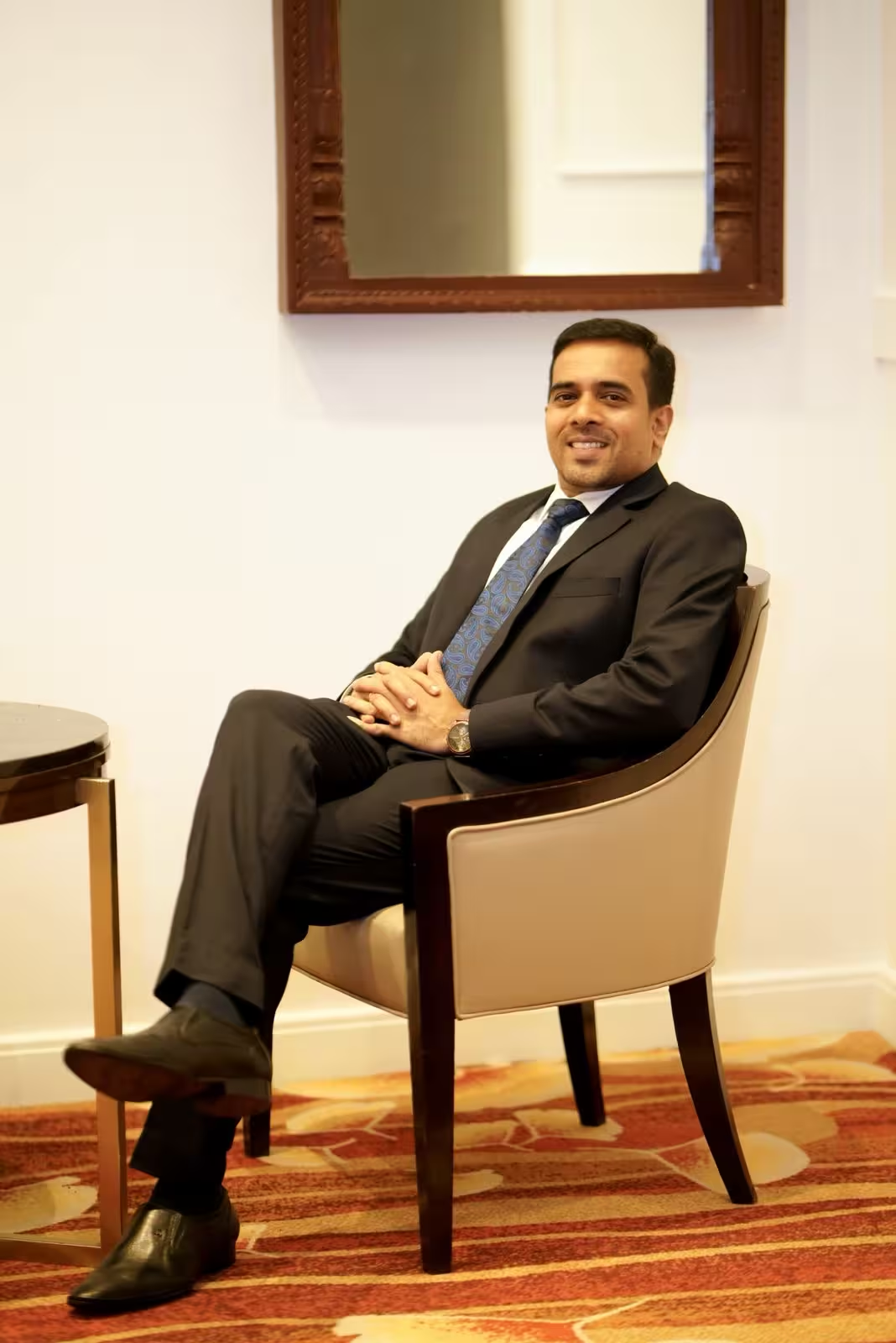
Krishnakumar K T
The reason any of this is worth writing down is that the pattern of the visionary entrepreneur in Kerala is learnable, at least partly, and it is learned considerably faster with somebody who has already been through the wrong-for-four-years phase.
Krishnakumar spent 16 years in banking and the NBFC sector, rising from a junior position to National Head at ESAF Small Finance Bank, then founded the Oleevia Group of Companies — 16 companies and services spanning finance, agriculture, education, food, arts and media, with a group net worth of ₹500 crore. He founded an RBI-licensed NBFC lending to street vendors and small entrepreneurs. He introduced the world’s first paid menstrual wellness leave policy in the private corporate sector. He runs two social trusts, a free arts academy, and a youth forum connecting young people in the state to scientists, civil servants and technologists.
The advisory work follows from all of it rather than sitting alongside it. As a Business Leader & Entrepreneur in India who has carried the risk personally, and as a Business Mentor in Kerala working with founders, leadership teams and NRIs, the conversation tends to start in the same place: what are you building that will not pay you back this year, and are you certain you can hold it long enough.