Entrepreneurs are often told to “focus.” Pick one thing, dominate it, then expand. When I tell people I’ve built 12 companies across industries as diverse as banking, organic food, arts education, and youth development, the first question is always: “Why didn’t you just scale one business?”
My answer challenges conventional wisdom: because India’s problems aren’t siloed, our solutions shouldn’t be either.
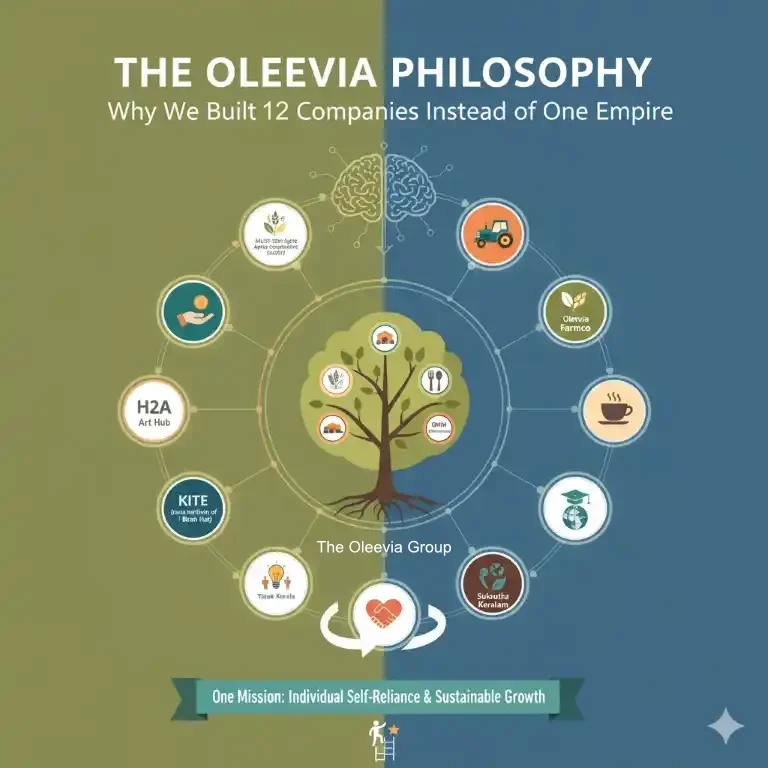
The Oleevia Group isn’t a conglomerate built through acquisition or opportunistic diversification. It’s an ecosystem designed with architectural precision, where each company addresses a specific social challenge while strengthening the others. Let me explain the philosophy behind this unusual structure.
The Interconnected Design
When we started Oleevia Grameen Credits as an RBI-licensed NBFC, we weren’t just entering the microfinance space. We were creating the financial backbone for every other initiative. Street vendors who get loans often become customers at OWN Restaurant. Farmers financed through our Multi-State Agro Cooperative Society supply organic produce to Oleevia Farmco, which then feeds our food businesses.
JIB (Jnan Institute of Bharat) trains youth in skills, KITE Dream Hub gives them entrepreneurial education, and then Oleevia Pvt Ltd—our business consultancy—helps them launch startups. Some of those startups receive funding from our NBFC. See the circle? That’s not coincidence; that’s intentional ecosystem architecture.
Why Ten Companies Make Sense
Each venture under Oleevia Group targets a specific market failure:
Oleevia Grameen Credits addresses financial exclusion. Our Multi-State Agro Cooperative tackles agricultural vulnerability. Oleevia Foundation (our NGO) fills the gap in comprehensive social support for marginalized communities—tribal groups, transgender individuals, and fishermen who fall through every other safety net.
OWN Restaurant and Chai by Own weren’t just about entering the food industry. They solve the problem of finding genuinely organic, healthy food in a market flooded with false claims. When we say coconut oil and homemade spices, we mean it—because we control the supply chain through Oleevia Farmco.
H2A Art Hub provides free arts training because unemployment isn’t just about lack of jobs; it’s about lack of confidence, creativity, and cultural connection. Traditional performance arts teach discipline, teamwork, and presentation skills—attributes that transform any career.
Think Kerala creates a forum for 18-30 year olds to engage with scientists, IAS officers, and technocrats because young people need inspiration and networks, not just education. Sukrutha Keralam mobilizes global Malayali resources for crowdfunding because the diaspora wants to contribute but lacks trusted platforms.
Ethical Business as Core Strategy
Throughout my 16 years in the NBFC sector, rising from junior employee to National Head at ESAF Small Finance Bank, I witnessed the cost of short-term profit maximization. Companies that treated customers as transactions eventually lost both trust and market share.
At Oleevia, ethical business practices aren’t CSR add-ons—they’re our competitive advantage. When farmers know we’ll pay fair prices, they give us their best produce. When employees know we value differently-abled individuals and tribal workers equally, they bring loyalty money can’t buy. When customers know our organic certification is genuine, they become ambassadors.
The Challenge of Complexity
Managing 10 companies and 2 trusts simultaneously isn’t easy. I won’t romanticize the chaos. There are days when I’m solving a regulatory challenge at the NBFC in the morning, reviewing restaurant operations at lunch, and attending a Think Kerala event with young innovators in the evening.
But my BSc in Physics, MBA from IIM, and professional social work training taught me systems thinking. Each business operates independently with strong leadership, but they share a common DNA: the mission to make individuals self-reliant and the vision of ethical, sustainable growth.
The Results Justify the Approach
We’ve created over 500 jobs. We’ve provided financial services to thousands who were “unbankable.” We’ve trained countless youth in arts and skills. We’ve connected global Malayalis to meaningful impact projects. We’ve served healthy food while supporting small farmers. We’ve given tribal and transgender communities dignity and opportunity.
Could we have helped more people by building one massive company? I don’t think so. A single company optimizes for a single metric. An ecosystem optimizes for comprehensive impact.
Looking Forward
As we work toward transforming Oleevia Grameen Credits into a fully digital bank, we’re not abandoning our diverse portfolio—we’re strengthening the ecosystem. Digital banking will make our financial services more accessible, which will help more entrepreneurs, which will expand markets for our other ventures, which will create more jobs, which will strengthen communities.
Our expansion isn’t about building an empire—it’s about building resilience. When one sector faces challenges, others provide stability. More importantly, we’re proving that businesses can prioritize people and planet alongside profit without sacrificing growth.
To fellow entrepreneurs wondering if they should diversify or focus, I say: understand your “why” first. If you’re building for exit value, focus ruthlessly on one vertical. But if you’re building to solve interconnected social problems, embrace complexity. Design for ecosystem effects. Build businesses that make each other stronger.
The Oleevia Philosophy is simple: India’s challenges are interconnected, so our solutions must be too. Ten companies, one mission, endless possibilities.
What’s your take on this approach? I’d love to hear from entrepreneurs, social workers, and change-makers in the comments below.