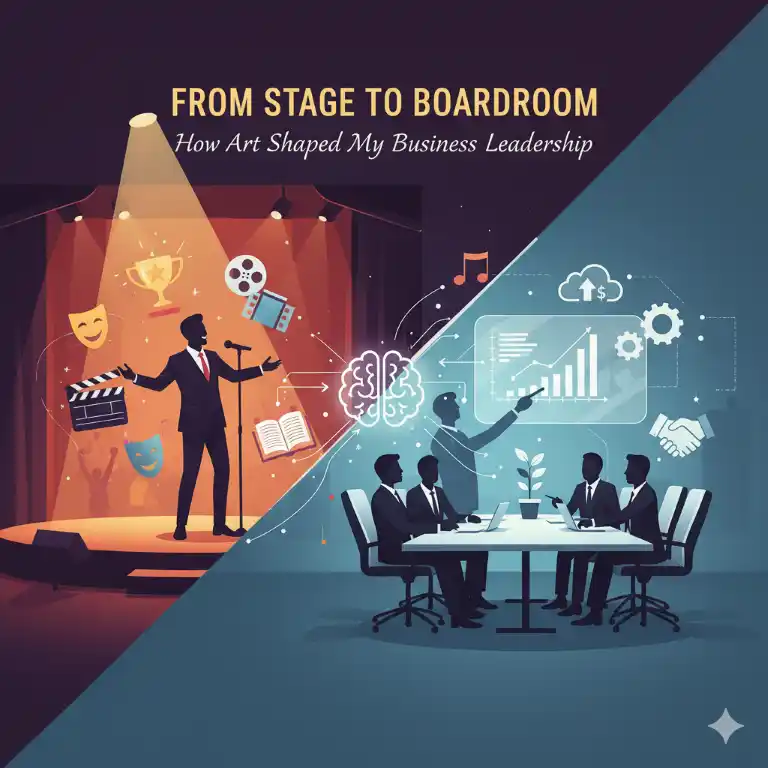
When people learn that I’ve performed over 1500 stage shows across India and also built 10 companies from scratch, they often ask: “How do you balance art and business?” My answer surprises them—I don’t balance them. They fuel each other.
Standing on stage at the Calicut University Interzone competition, winning that mimicry trophy, taught me something no MBA classroom ever could: the power of reading your audience. Every laugh, every moment of silence, every spontaneous reaction became data. I learned to pivot mid-performance, to sense when energy was dropping, and to deliver exactly what people needed in that moment.
Today, when I walk into a boardroom meeting at Oleevia Group, I use those same instincts. Whether I’m pitching financial inclusion to rural communities through Oleevia Grameen Credits or explaining our organic food vision at Oleevia Farmco, I’m essentially performing—not to entertain, but to connect, inspire, and move people toward action.
My journey from winning silver at the South India Inter-University Festival to appearing in “Navaagatharkku Swaagatham” alongside Mukesh and Jyothirmayi wasn’t just about artistic achievement. Each performance was a masterclass in resilience, timing, and understanding human psychology. When Asianet’s “Smile Please” crowned me Best Comedian, I wasn’t just winning a title—I was earning a PhD in emotional intelligence.
This artistic foundation became my secret weapon in banking and finance. During my 16 years rising through the NBFC sector to become National Head at ESAF Small Finance Bank, I realized that financial services aren’t about numbers—they’re about people. The street vendor who needs a small loan isn’t a risk assessment; she’s a mother with dreams, anxieties, and potential. Art taught me to see that humanity.
When I founded Oleevia Group, I deliberately wove creativity into our DNA. At H2A Art Hub, we provide free arts training to unemployed youth—not as charity, but as strategic empowerment. I’ve witnessed firsthand how a young person who masters traditional performance arts gains confidence that transforms their entire approach to life and work.
The same creativity that makes audiences laugh now solves business problems. When designing our OWN Restaurant concept, I didn’t just think about organic food—I choreographed an experience. The use of coconut oil, homemade spices, and hygienic presentation isn’t just healthy eating; it’s performance art you can taste.
At Think Kerala, our youth forum for 18-30 year olds, we don’t hold conventional seminars. We create interactive sessions where young minds engage with IAS officers, scientists, and technocrats. It’s theater meets think tank—and it works because people remember experiences, not lectures.
My artistic journey hasn’t ended; it’s expanded. Every business decision is creative. Every team meeting is a performance. Every challenge is an opportunity for improvisation. The 100,000-strong network I’ve built globally isn’t just contacts—it’s an audience that became a community.
To young entrepreneurs reading this: don’t compartmentalize your talents. That hobby you love, that creative pursuit you think is “just for fun”—it might be your greatest business asset. Your unique combination of skills is your competitive advantage.
Art taught me that failure is just another performance, not the final curtain. When things don’t work, you take a bow, learn from the audience’s response, and come back stronger. This mindset has been invaluable in entrepreneurship, where every venture teaches lessons that inform the next.
As I expand Oleevia Group’s reach and prepare for our digital banking future, I carry the artist’s toolkit: empathy, timing, creativity, resilience, and the courage to stand in front of any audience—whether it’s a rural farmer, a government official, or an international investor—and tell a story they’ll never forget.
The stage lights and boardroom spotlights aren’t different worlds. They’re two verses of the same song—one I’ll keep performing for as long as I can make a positive difference in people’s lives.